Your tools stay where they are. Your operations stop being fragmented.
Ranko makes stores, e-commerce, stock, logistics and head-office teams work as a single network. Without replacing your ERP, your POS or your e-commerce platform: by connecting what already exists and running the day-to-day flows.
Brands already run on Ranko every day.
A central platform for some, a precise scope for others: Ranko is deployed where the need is sharpest, then extends from there.
An e-commerce site connected to the entire store network
Catalogue, stock, orders, Click & Collect, in-store fulfilment and logistics all work on the same layer. The website and the stores form a single commercial operation: store teams take part in fulfilling web orders, and the customer experience stays the same whichever channel they buy from.
Smoother exchanges with brands and suppliers
The rollout starts with supplier exchanges and the ordering process: a precise scope, extensible afterwards.
The problem isn't the tool. It's the space between the tools.
Each system does its own job properly. It's the hand-offs — web to store, store to warehouse, field to head office — that cost time, margin and the promise made to the customer.
Two stock figures for the same product
The website shows availability the store cannot honour, and the store holds stock the website never sells.
Store fulfilment is run over the phone
Who is picking, who declined, who is late: the information travels through messages and calls, outside the tools.
The information lives in five places
ERP, e-commerce, spreadsheets, emails, third-party logistics. Every team works from its own version of the truth.
Head office finds out about exceptions too late
Delays, declined fulfilment requests and stock-outs surface after the fact, once the customer has already waited or cancelled.
Manual steps between every tool
Exports, re-keying, copy-paste: team hours spent every week gluing systems back together.
Ranko doesn't replace your systems. It makes them work together.
A single layer that reads existing flows, reconciles discrepancies and triggers the right action in the right place: in store, at the warehouse, at head office.
Stock, sales, orders, products and reference data are pulled from wherever they already live.
Discrepancies between channels are matched, logged and corrected instead of being discovered.
Picking requests, syncs, alerts and follow-ups go out automatically to the right team.
Three changes teams notice first.
Make the customer promise reliable
What is shown as available genuinely is. What is ordered gets allocated, picked and tracked through to collection or delivery.
Let stock flow both ways
The store is no longer on the receiving end of the website: it becomes a stock, fulfilment and collection point. And it sells in turn, drawing on the warehouse and on the other stores in the network.
Manage exceptions instead of absorbing them
Normal flows run on their own. Head-office teams focus on the outliers: refusals, delays, stock-outs, sync errors.
Does any of that describe your operations?
Book a demonstration ↓What Ranko runs day to day.
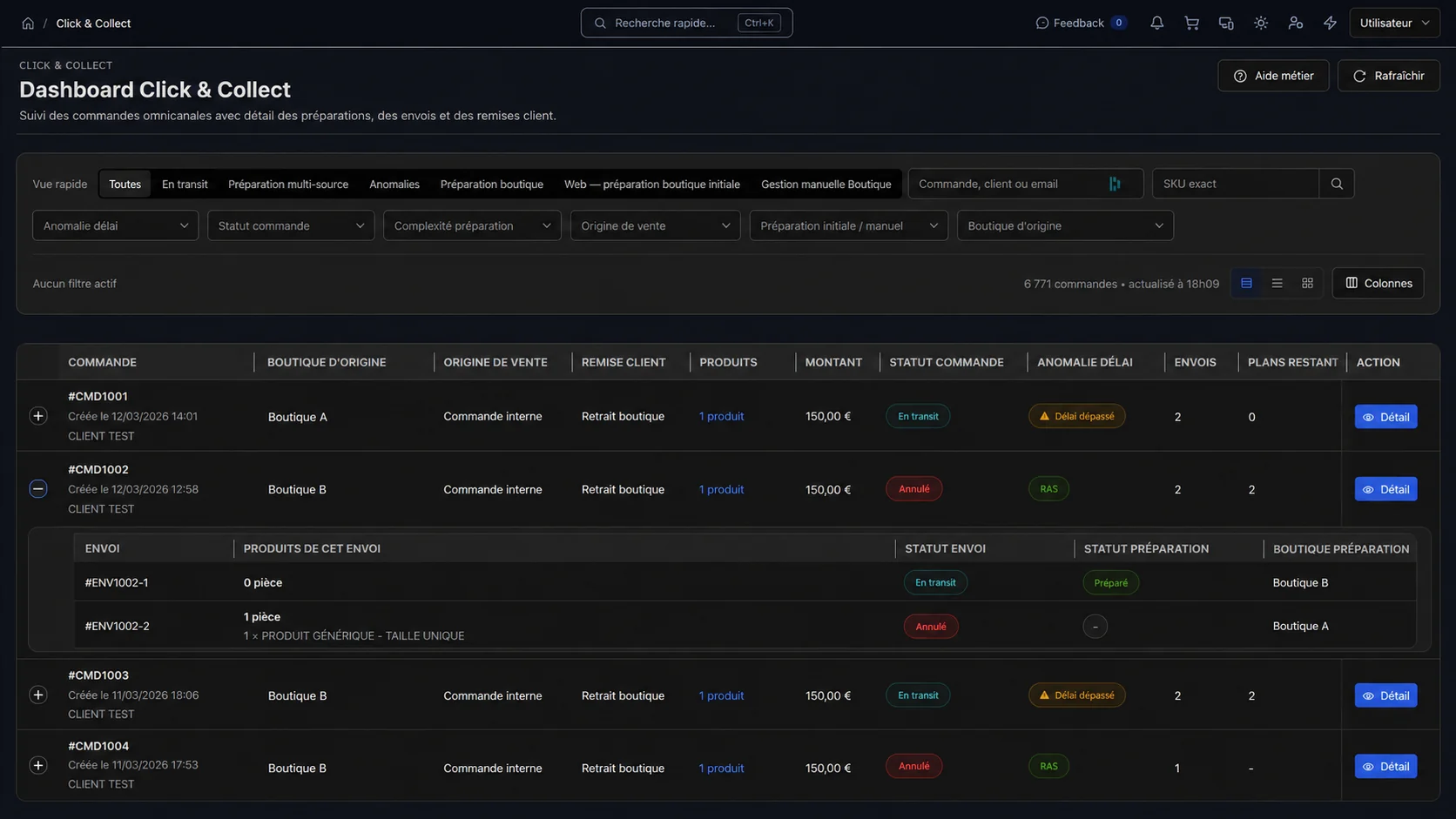
A web order picked by the right store, with no manual arbitration.
Ranko picks the fulfilment point based on real stock, quotas, closures and configurable scoring. The store accepts, picks and labels. If it declines or misses the deadline, the outstanding items are reallocated automatically.
An item is sellable even when it isn't in the store.
The warehouse and the other stores become stock sources for the sale. A store closes a sale on a product that isn't on its floor, and the website works from the network's real stock rather than a projection.
One product record for every channel.
Variants, sizes, materials, care instructions, AGEC traceability, SEO: product data is held in one place, then pushed out to e-commerce, the POS and business files.
Day-to-day Shopify is run from Ranko.
The Ranko product record creates and updates the Shopify product, with data checks before anything is sent. Stock, prices, collections and discounts follow automatically. And what happens on the site — stock-outs, pre-orders, abandoned carts, gift cards — comes back into Ranko.
From purchase order to goods-in, in one thread.
Orders, quantities, receipts, documents and production tracking stay attached to the product data instead of living in separate spreadsheets.
A status that reads end to end.
Payment, picking, transit, collection, return, cancellation: every step is time-stamped and traceable, in store as at head office.
The store view and the network view, without reading twice.
Today's sales, year-on-year comparison, footfall, product and category performance: the same indicators for one store or for the whole network.
Knowing whether a store can take payment, right now.
Network, 4G, telephony and the till itself are combined into a per-store diagnosis. When an incident happens, it becomes a tracked request routed to the right provider, instead of a call into the void.
The routine runs itself, the exceptions surface.
Scheduled syncs, follow-ups, deadline reminders and push notifications: teams are called on when a decision is needed, not to watch screens.
A broad foundation. You switch on only what you need.
Ranko covers the full chain, from product to payment. Each area unfolds below, and a rollout starts with just one of them before extending.
01 Catalogue & product data One record feeds the POS, the website, the books and the exports. +
Product reference data built for fashion: variants, colours, sizes and size grids are native, as are seasons and collections.
02 Stock & availability Stock that isn't just consulted — it's consumed by decisions. +
Store view and network view, down to size, colour and barcode, kept in sync with the POS, the e-commerce site and the warehouse.
03 Omnichannel & Click & Collect The whole catalogue sellable from any point in the network. +
Stock stops belonging to the place where it sits idle. A web order goes to the right store or to the warehouse, chosen by a scoring engine; conversely, a store closes a sale on an item that isn't on its floor by having it sent from the warehouse or another store.
04 Payment & till A full POS, optional: you are not locked in anywhere. +
Ranko already talks to two POS-ERP systems on the market, and ships its own point of sale, built to the NF525 / ISCA requirements.
05 Promotions & campaigns A discount is configured once and goes out to the POS and the website. +
Ranko becomes the source of truth for promotions: the same mechanics in store and online, testable before publication.
06 Purchasing, suppliers & production From purchase order to goods-in, in one thread. +
Purchasing stays connected to product data, to production tracking, and to the supplier itself, who fills in their own information through a secure form.
07 Store network & field “Can this store take payment, right here, right now?” +
A supervision module retail ERPs don't offer: network, 4G, SIM, telephony and the till combined into a per-store diagnosis.
08 Teams & field HR Network HR — the part classic HRIS platforms handle badly. +
Actual attendance, cover between stores, scheduling under constraints: Ranko covers day-to-day HR on the ground.
09 Customers, marketing & reporting A CRM fed by real operations, with no double entry. +
Sale, collection, stock-out, basket, birthday: every event feeds customer knowledge, and head office reports on the same data.
Every capability listed here is in production. The detail — screens, configuration, the particulars of your organisation — is shown in a demonstration, on your real flows.
Ranko adapts to your ecosystem. Not the other way round.
The connections below are proof of capability, not prerequisites: two different POS-ERP systems, an e-commerce platform, a third-party logistics provider, a carrier, an accounting tool, two CRMs. If your tool exposes an API, webhooks or file feeds, it can join the list.
 Shopify




Also in place: Alma (split payment) · Log'nc (logistics) · 3CX (store telephony) · Atera, UniFi, FreePro, EMA (IT & telecom monitoring) · OpenAI · DeepL.
None of these tools is imposed, and none is a gateway you have to go through: changing your POS, your CRM or your carrier does not put Ranko back in question. The exact scope of a new connection — what it covers, what it requires — depends on what the tool exposes, and is assessed case by case. It is one of the first topics of a scoping conversation.
Let's look at what can be orchestrated at your end.
A demonstration starts from your real flows: your channels, your stores, the tools you already run. An hour is enough to identify what can be orchestrated.
Audience measurement only, no advertising cookies. Learn more.